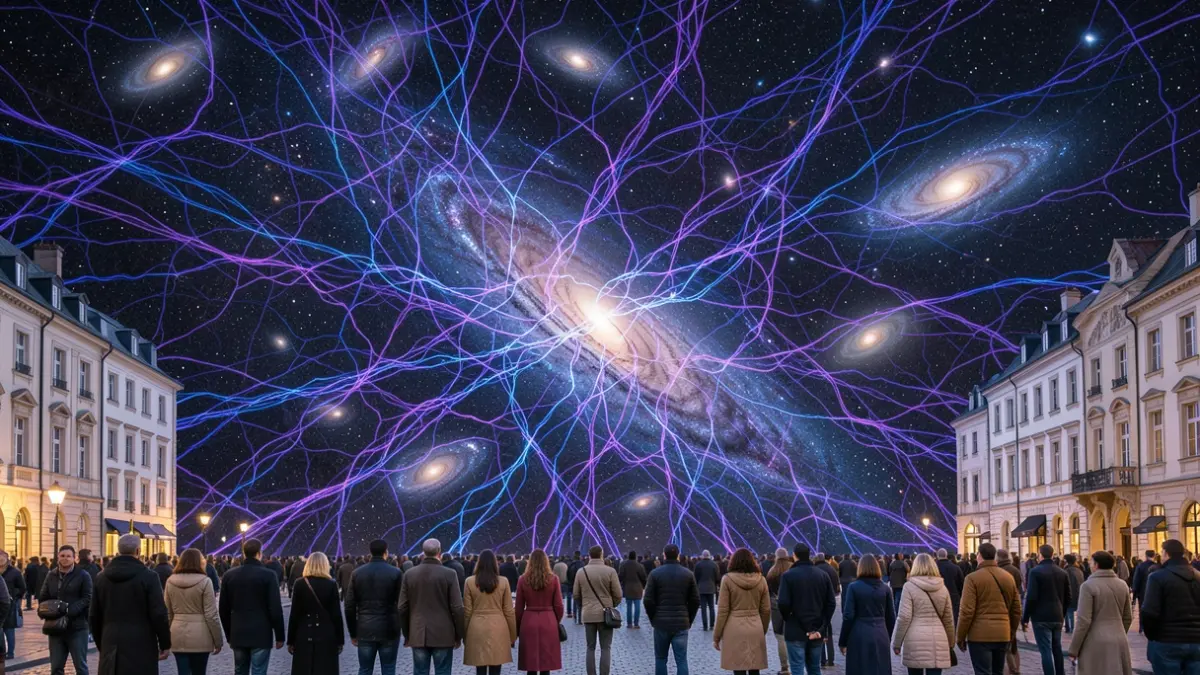
An international team, part of the MeerKLASS Collaboration and including researchers from The University of Manchester, has successfully measured how neutral hydrogen clumps together in the distant Universe. This significant advancement, published in Monthly Notices of the Royal Astronomical Society, uses a technique called 21-cm intensity mapping.
This method measures the combined radio emission from hydrogen across vast areas, allowing astronomers to study the Universe's structure more efficiently, even when individual galaxies are indistinguishable. The survey covered approximately 250 square degrees of sky, with signals originating from about 4.5 billion years ago, when the Universe was just over nine billion years old.
“"This is a major milestone after a decade of preparation and hard work. By measuring the combined signal from hydrogen across huge areas of the sky, we can trace the cosmic web and build a picture of how the Universe’s structure has evolved over time."
Overcoming significant 'noise' from other astrophysical sources, the team employed a new observing mode for MeerKAT, where each of its 64 dishes operated independently. This approach allowed for the confirmation of a signal more than six times above statistical noise, establishing 21-cm intensity mapping as a valuable cosmological tool.
“"This measurement took a decade of patient work by researchers spread across seven countries and three continents — and many of them are early-career scientists who have spent their whole career on this project. Such an ambitious result requires sustained and genuine teamwork from many people."
The MeerKAT telescope's sensitivity and stability, supported by the South African Radio Astronomy Observatory (SARAO), were crucial for this measurement. The MeerKLASS Collaboration continues to collect data, aiming to map an even larger volume of the Universe and investigate its expansion and the growth of cosmic structures over time.